TL;DR
Problem: Indonesia's informal digital marketplaces ran on Facebook groups and manual escrow, breaking down as transaction volume grew.
Role: Sole UI/UX Designer across both apps. Owned end-to-end experience design and the product decision to split escrow into its own product.
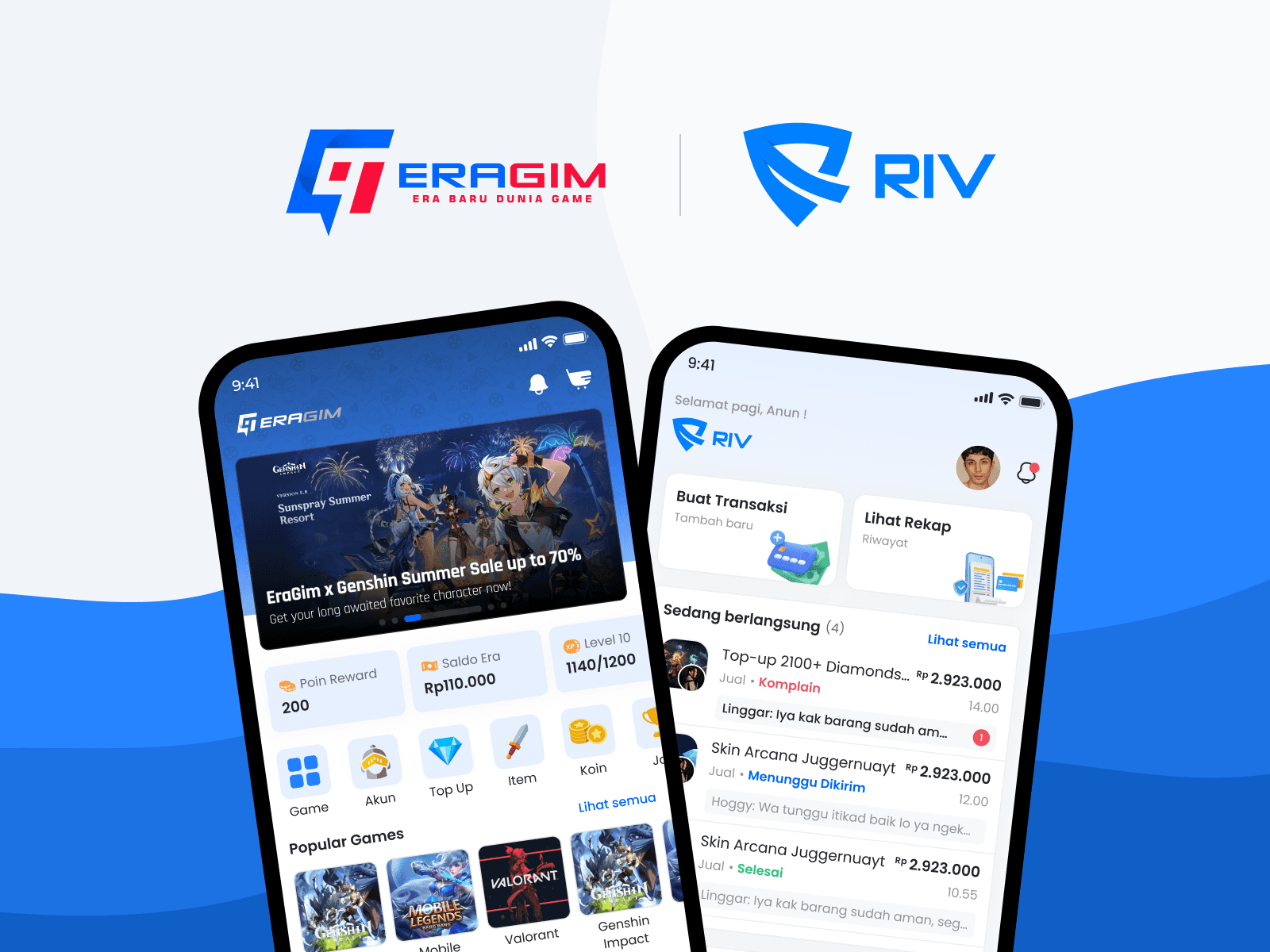
Solution: A two-app ecosystem. Eragim as the gaming-native marketplace with built-in escrow, and Rekber RIV as a standalone escrow layer serving transactions beyond gaming.
Design deliverable: End-to-end buyer, seller, and admin workflows covering discovery, checkout, wallet top-up, escrow, payment release, verification chat, and CMS management.
The Challenge
Eragim grew up inside Facebook groups. Buyers and sellers of gaming accounts, items, and top-ups negotiated through comments, transferred money directly, and relied on a handful of trusted middlemen to hold funds during the transaction. It worked, until it didn't. As Eragim's customer base grew, the manual process broke. Slow escrow turnarounds, inconsistent dispute handling, no record-keeping, and rising trust friction. Competitors like Itemku already ran proper platforms, and Eragim was vulnerable despite a loyal user base.
There was a second, bigger insight behind the project. Eragim's escrow capability was valuable outside of gaming too. Other peer-to-peer marketplaces in Indonesia, for digital services, second-hand goods, and niche verticals, had the same trust problem with no standardized solution. So the design challenge wasn't just "build a marketplace app." It was: how do you design a system that serves Eragim's gaming community and also lets the escrow layer stand on its own for other marketplaces to plug into?
My Role
Sole UI/UX Designer across both products. I owned the end-to-end experience—research, user flows, high-fidelity UI, design system, interactive prototypes, and developer handoff—for Eragim, the consumer-facing marketplace, and Rekber RIV, the standalone escrow product. I worked with the client and product team to define what each product should and should not do, then extended the same transaction model into the admin CMS for product, order, and user management.
System-Level Decision: Why Two Apps?
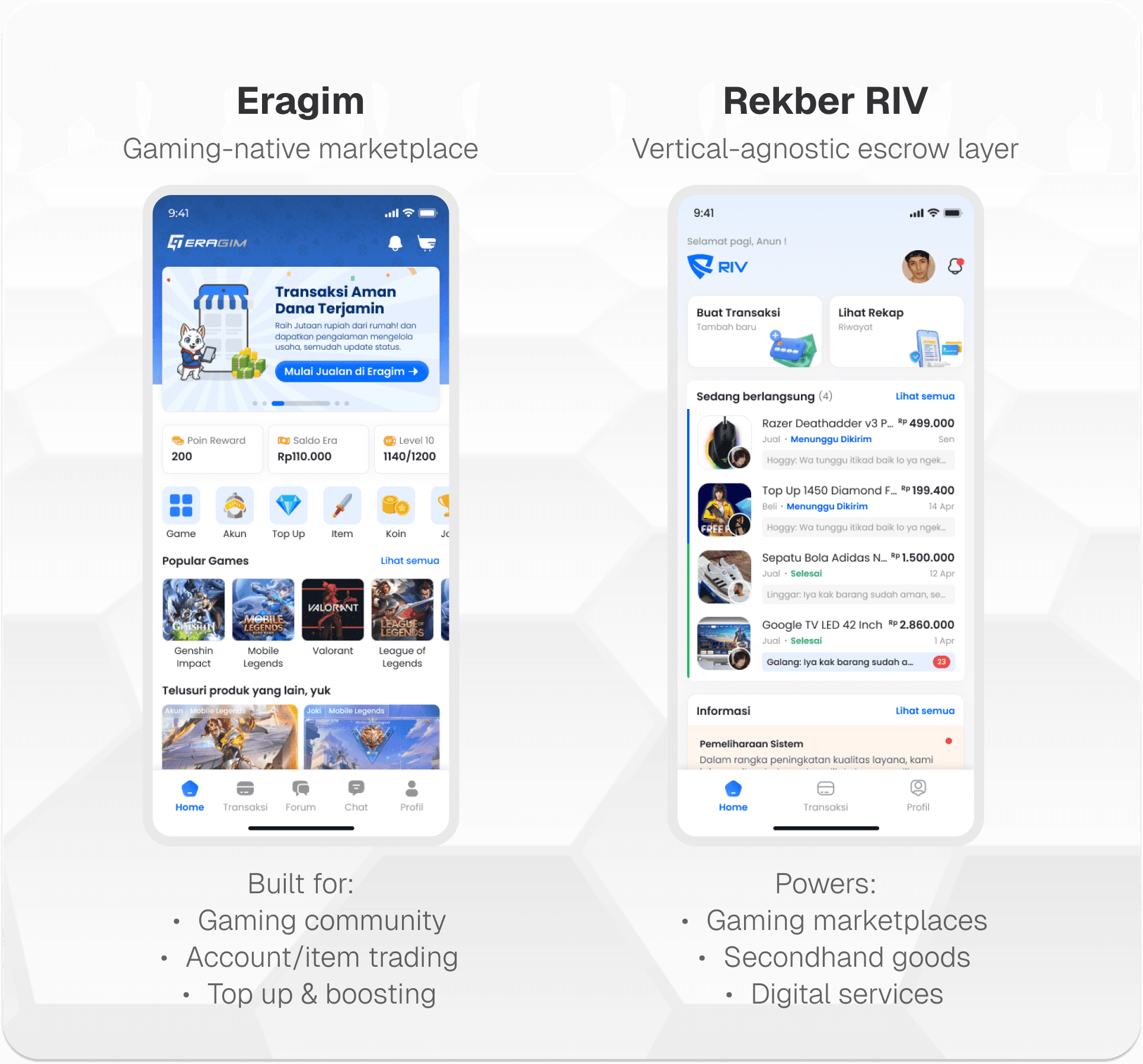
The most important design decision on this project wasn't a screen. It was the decision to build two apps instead of one.
A single-app approach would have been simpler. Keep escrow as a feature inside Eragim, ship faster, reduce engineering overhead. But it would have also locked the escrow logic inside a gaming-native product, making it unusable for any marketplace that wasn't about games.
Splitting into two apps solved three problems at once:
- Eragim could stay gaming-native. Visual language, copy, product metaphors, and community features could all be optimized for gamers without compromising for "neutral marketplace" aesthetics.
- Rekber RIV could stay vertical-agnostic. Clean, trust-forward, minimal branding, designed so any marketplace could plug it in without inheriting Eragim's gaming identity.
- Each app got the UX priorities it actually needed. A consumer marketplace needs discovery, browsing, and community. A neutral escrow layer needs clarity, status transparency, and dispute handling above all else.
This was the decision that turned a marketplace redesign into a two-product ecosystem.
The Solution
Eragim, the gaming-native marketplace
Automated Escrow System. A three-party payment flow where Eragim holds buyer funds until both parties confirm completion, replacing manual middleman handling with systematic trust at scale.
Secure Communication Hub. An in-transaction chat system so buyers can verify digital goods (game accounts, items, top-up details) before releasing payment. The design goal was to reduce avoidable disputes by keeping verification evidence and transaction status in one place.
Community-Driven Marketplace. Integrated seller forums for reputation-building and product promotion, turning one-off transactions into a persistent seller ecosystem. Sellers build reputation, buyers gain confidence, and the community feel of the original Facebook groups survives the move to a structured platform.
Rekber RIV, the standalone escrow layer
Three-Party Transaction System. A clean, vertical-agnostic escrow flow designed to serve transactions beyond gaming. Digital services, peer-to-peer goods, any context where strangers exchange money and something in return.
Reusable Trust Components. A small, disciplined set of UI patterns (verification badges, status chips, release confirmations, dispute indicators) designed as a system so trust signals stay consistent across any marketplace integration.
Buyer, Seller, and Admin Flows. Three distinct role-based experiences sharing the same underlying state model, so the three sides of a transaction always see a consistent view of the same truth.
Key Design Challenges
- Translating an informal Facebook-group culture into a structured platform without losing the community feel users were loyal to. Eragim users weren't asking for a "professional app." They were asking for the same community with less friction.
- Designing two products that share DNA without feeling like copy-paste. Eragim and Rekber share escrow primitives but serve different audiences. Same underlying trust logic, deliberately different interfaces.
- Making escrow legible to users with varying fintech literacy. Escrow design is state-machine design. Every screen has to answer "where am I, what happens next, who's responsible right now," and if any of those are unclear, trust collapses instantly.
- Balancing speed with security. Buyers want fast payment release. Sellers want dispute protection. The release flow had to feel fast enough for low-stakes transactions and safe enough for high-value ones.
Design Outcome and Status
The completed design translated a Facebook-group workflow into a two-product system: a gaming-native marketplace and a reusable escrow experience. The deliverables covered the full journey from discovery to checkout and in-transaction verification across buyer, seller, and admin roles, including wallet top-up and payment states.
The product was designed to give sellers a structured storefront and reputation model, give buyers clearer transaction safeguards, and give admins consistent tools for managing products, orders, users, and disputes. Public post-launch adoption or conversion metrics are not available, so this case study reports the verified design scope rather than presenting projected benefits as measured outcomes.
What I Learned
Trust in fintech isn't built through security badges. It's built through every micro-interaction in the flow. Clear status, honest communication, and visible accountability matter more than any single "secure" label.
The bigger lesson was about product scope. Splitting one product into two was the harder path, but it was the path that created optionality. A gaming marketplace and a marketplace-agnostic escrow layer, built from shared primitives. That principle of designing systems, not just screens, now shapes how I approach any product involving money between strangers.